A step-by-step guide: which materials to use, how to protect fragile items, liquids and electronics, when you need a wooden crate, and how to label each package so your cargo reaches the recipient intact.
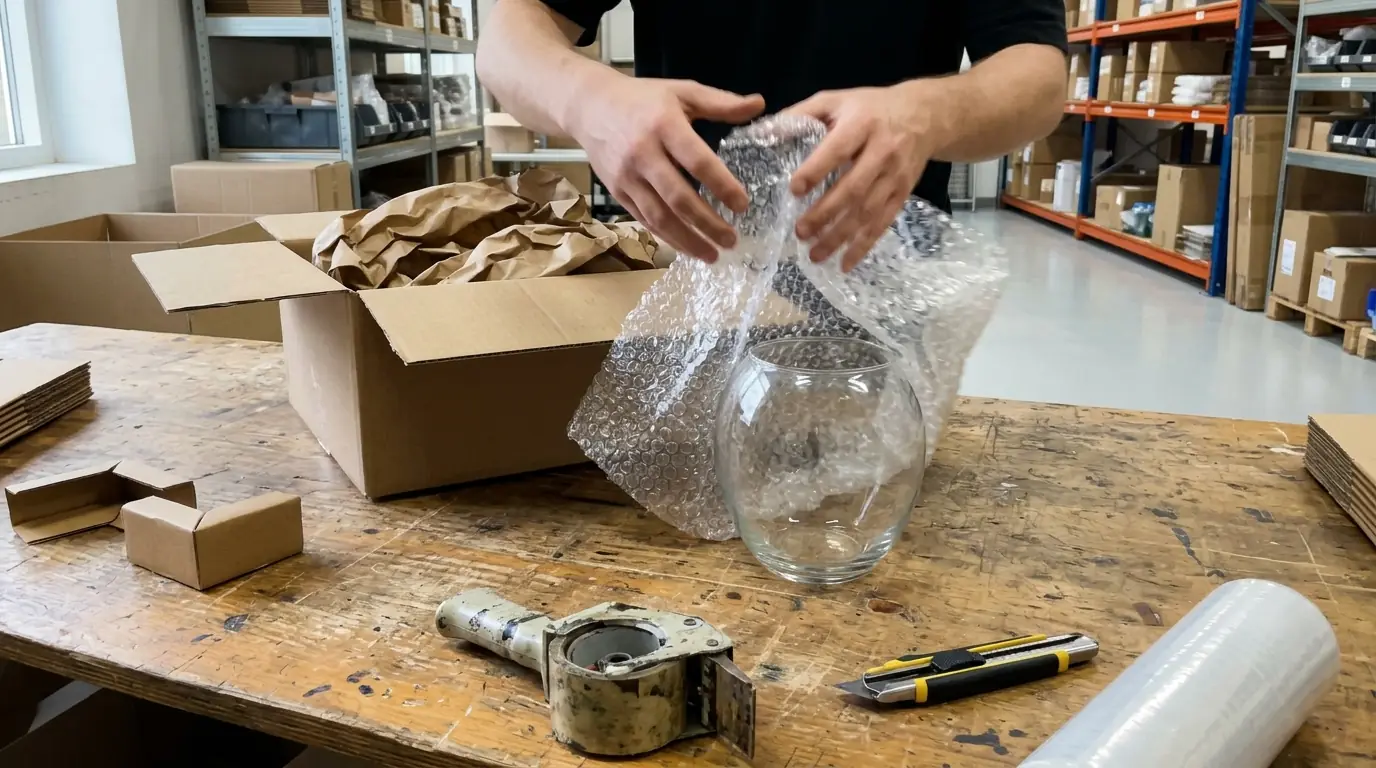
Packing cargo for shipping is more than a box and some tape. The packaging has to withstand shaking, reloading, pressure from neighboring packages and temperature swings for the entire journey.
And that journey on the Moscow–Tashkent route varies a lot: by plane cargo flies 10–24 hours, by train it travels about 4 days, and by truck it takes 10–15 days in transit through Kazakhstan, with several loadings and unloadings. That is why the same item is packed differently for a plane and for a truck.
Below you will find materials, rules for fragile items, liquids and electronics, package labeling and a checklist before you hand over your cargo.
In short
- The main ruleNothing should move inside, and the box should not cave in under the weight of neighboring packages.
- Fragile itemsEach item is wrapped separately, sits in the center of the box on a layer of filler and does not touch the walls.
- When to leave packing to usElectronics, glass, equipment, furniture and valuable cargo. YolEx packs at the warehouse and sends a photo report on request.
What to pack cargo in: materials and when you need them
Materials are chosen for the cargo and the mode of transport: the longer the trip and the more reloading, the sturdier the outer packaging must be.
Outer packaging protects against impacts and pressure; inner packaging protects against shifting and vibration. The most common mistake senders make is a good box that is empty inside: at the very first reloading, items knock against each other.
| Material | Purpose | When it is a must |
|---|---|---|
| Corrugated cardboard | Outer packaging | For almost any cargo; for heavy items, multi-layer with rigid walls |
| Bubble wrap | Shock absorption | Glass, ceramics, electronics, instruments |
| Paper, corrugated inserts, foam | Filling empty space, custom inserts | When the item is smaller than the box; foam inserts for bottles and instruments |
| Stretch film | Protection from moisture and dirt, bundling packages together | Bags, textiles, furniture, pallets, several boxes from one sender |
| Corner and edge protectors | Protecting edges and corners | Furniture, flat packages, equipment |
| Wooden crate or box | A rigid frame around the cargo | Heavy, fragile and expensive cargo, especially by truck: the Moscow–Tashkent trip takes 10–15 days |
← Swipe to scroll the table →
Do not reuse boxes with old stickers and barcodes: they cause mix-ups during sorting. And do not skimp on tape: seal the seams crosswise along every joint, top and bottom.
Packing fragile cargo and liquids
Fragile cargo is packed using the “box in a box” principle: each item is wrapped separately, with a cushioning layer between it and the walls.
Tap a step to see the details.
Wrap each item
Several layers of bubble wrap, with extra wrap on protruding parts. Dishes and glass are never nested inside each other without padding.
Prepare the bottom
Put a thick layer of filler on the bottom of the box so that an impact from below does not reach the item.
Place it in the center
The item must not touch the walls. Heavy items go at the bottom, light ones on top.
Fill the empty space
Filler on the sides and on top. Test: shake the box, and nothing inside should shift.
Seal and mark
Tape crosswise, a “Fragile” sign and “This side up” arrows on the sides. Let the logistics manager know there are fragile items in the shipment.
How to pack liquids
Close bottles and jars tightly, secure the caps with tape and put each container in a separate bag. This way a leak will not ruin neighboring items, whether yours or someone else's in a consolidated shipment.
If the liquid cannot handle freezing temperatures and you are shipping by train or truck in winter, discuss air freight with the logistics manager. Flammable liquids and aerosols are restricted goods and can only be shipped under the carrier's rules.
What this looks like in practice: we placed glass sample bottles in a foam insert and protected them with bubble wrap, and in the fragrance samples case study every bottle reached Tashkent intact.
How to pack electronics, metal and heavy cargo
Heavy cargo is a danger not only to itself but also to its neighbors in the truck: if it shifts, it damages everything around it.
Rules for electronics and heavy packages:
- Electronics are best shipped in the original box with the original inserts. If you do not have it, use a snug insert and a rigid outer box.
- Secure moving parts; remove detachable parts and pack them separately.
- Agree on devices with batteries with the logistics manager in advance: lithium batteries are shipped under special rules, especially by plane.
- Wrap metal parts in anti-corrosion paper to protect them from moisture and condensation.
- Put heavy packages on a pallet and strap them down; fragile heavy cargo goes in a wooden crate or box.
Packing requirements depend on how long the cargo spends in transit and how many times it is reloaded. Choose a mode of transport to see the difference.
Moscow–Tashkent transit time by mode of transport. YolEx data, November 2026.
- 10–24 hin transit Moscow–Tashkent
- Volumeaffects the price: extra air in a box is expensive
The trip is short, and for most items a sturdy box with cushioning is enough. On the other hand, the rules for batteries, aerosols and liquids are stricter, and the packaging should be kept compact.
- ~4 daysin transit Moscow–Tashkent
- Vibrationand tight stacking in the railcar
Boxes are stacked in rows and secured with straps, so the top ones press on the bottom ones. You need rigid packaging, and metal should be wrapped in anti-corrosion paper.
- 10–15 daysin transit Moscow–Tashkent
- Palletand securing in the trailer
The longest trip, with transit through Kazakhstan and temperature swings. Fragile and heavy items go in a crate; packages go on pallets wrapped in stretch film.
For example, we wrapped a shipment of brake discs and filters for Samarkand in anti-corrosion paper and packed it in a wooden box with filler, and the parts from the auto parts case study arrived without corrosion.
Labeling packages: how to mark your cargo
Labels keep a package from getting lost at the warehouse or during reloading and make sure it is handled correctly.
- RecipientName, phone number, city and address in Uzbekistan
- SenderName and contact phone number
- Package number“1 of 4”, “2 of 4”: you can see right away whether all the boxes are there
- Handling signs“Fragile”, “This side up”, “Keep dry”
- Clean surfaceOld labels removed or covered
- Same on every boxDetails on each box, not just one
Label the box on the top and on one of the sides: when boxes are stacked, the top may be covered. Write with a marker or use a sticker protected from moisture with clear tape.
When accepting cargo at the warehouse, YolEx adds its own shipping labels to each package, but your label remains the main way to find a box quickly if something goes wrong.
When you need professional packing, and a pre-shipping checklist
If the cargo is expensive, fragile, heavy or oddly shaped, it is safer to leave the packing to a logistics company: it knows what the cargo will go through on the way.
YolEx packs cargo at the warehouse for the specific mode of transport: bubble wrap and stretch film, corner protectors, pallets, wooden boxes. On request we send a photo report showing how the cargo was packed and loaded.
Checklist before handing over your cargo:
- Nothing rattles or shifts inside when you shake the box.
- The box does not cave in when you press on the top and the corners.
- Liquids are closed, secured and placed in separate bags.
- Batteries, aerosols and medicines have been cleared with the logistics manager in advance.
- Every package has the recipient's details, a package number and the necessary signs.
- There is an inventory of contents with approximate values; it is needed for paperwork and for cargo insurance.
- The weight and dimensions of each package are measured for an accurate quote.
Compact packing also saves money. For light, bulky boxes the price may be calculated by volumetric weight, so extra air in a box costs more. Enter the weight and dimensions in the shipping cost calculator, and if you need packing, the logistics manager will add it to the quote.
Important
Even perfect packing does not make cargo acceptable if it is prohibited for the chosen mode of transport. Restriction lists are set by carriers and customs services, and they differ for air and ground shipping. If you are unsure about the contents, ask the logistics manager before packing.